

Investment Trends, Market Growth & What It Means for Businesses
Artificial intelligence is rapidly transforming the cybersecurity industry. In 2026, venture capital firms and enterprise investors are directing significant funding toward AI-driven security startups that promise faster threat detection, automated incident response, and improved risk management.
This article provides an original, policy-compliant overview of AI cybersecurity startup funding trends in 2026, key investment drivers, and what businesses should watch moving forward.
Why Investors Are Backing AI Cybersecurity in 2026

The increase in cyber threats, ransomware incidents, and cloud vulnerabilities has pushed organizations to seek advanced security solutions. AI-powered systems can:
Detect anomalies in real time
Predict potential attack patterns
Automate threat response
Reduce manual workload for security teams
Improve fraud detection accuracy
As digital transformation accelerates across industries, AI cybersecurity tools are becoming mission-critical investments.
Funding Trends in 2026
1. Growth in Early-Stage Investments
Seed and Series A funding rounds remain strong in 2026. Investors are prioritizing startups that focus on:
AI-based threat detection
Zero-trust security architecture
Cloud-native security platforms
Identity and access management (IAM)
Automated security operations (SecOps)
Venture capital firms are particularly interested in startups building scalable SaaS security platforms with recurring revenue models.
2. Enterprise-Focused AI Security Solutions
Funding is shifting toward startups serving enterprise clients, especially in sectors like:
Financial services
Healthcare
Government agencies
Critical infrastructure
E-commerce platforms
These industries face stricter compliance requirements and higher cyber risk exposure, making them attractive markets for AI security innovation.
3. Cloud & Multi-Cloud Security Investment
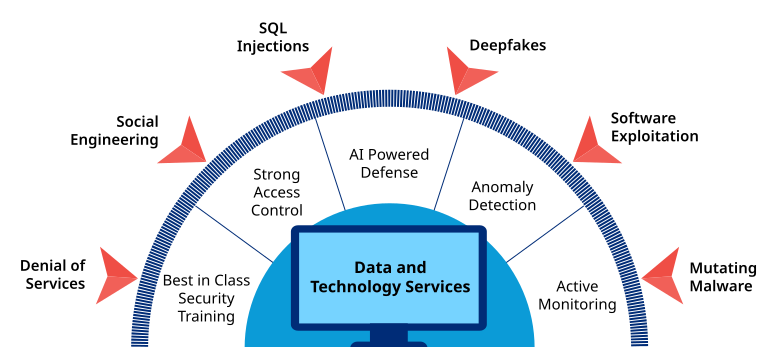
With businesses adopting hybrid and multi-cloud environments, investors are backing AI startups that:
Monitor distributed cloud systems
Detect misconfigurations automatically
Secure APIs and microservices
Provide real-time cloud threat intelligence
Cloud security remains one of the highest-growth segments in cybersecurity funding.
Key Drivers Behind AI Cybersecurity Funding
Increasing Ransomware Threats
Global ransomware incidents continue to impact enterprises, pushing demand for AI-based prevention systems.
Regulatory Pressure
Governments are strengthening cybersecurity and data protection regulations. Businesses must demonstrate compliance, which increases demand for automated monitoring tools.
Talent Shortages
There is a global shortage of skilled cybersecurity professionals. AI-powered tools help fill operational gaps by automating repetitive security tasks.
Rising Cost of Data Breaches
The financial and reputational cost of cyberattacks has increased significantly, encouraging proactive investment in prevention technologies.
Types of AI Cybersecurity Startups Attracting Funding
1. Behavioral Analytics Platforms
These startups use AI to analyze user behavior and detect suspicious activity patterns.
2. Autonomous SOC (Security Operations Center) Solutions
AI systems that automatically triage and respond to threats are gaining investor interest.
3. AI-Powered Fraud Detection
FinTech and e-commerce platforms are investing in fraud prevention powered by machine learning models.
4. API Security Startups
As APIs expand, startups focusing on AI-driven API threat monitoring are attracting funding rounds.
5. AI-Driven Endpoint Protection
Advanced endpoint detection and response (EDR) platforms remain a high-demand category.
Geographic Investment Hotspots in 2026
AI cybersecurity funding activity is strong in:
North America (especially the United States)
Western Europe
Israel’s cybersecurity ecosystem
Select Asia-Pacific innovation hubs
These regions benefit from established tech ecosystems, access to venture capital, and high enterprise demand.
What This Means for Businesses
1. More Competitive Security Solutions
Businesses will see more advanced AI-driven products entering the market.
2. Increased Vendor Options
The surge in startup funding expands the range of SaaS cybersecurity platforms available.
3. Faster Innovation Cycles
Startups backed by strong funding can accelerate product development and feature releases.
4. Greater Focus on Automation
AI-driven automation will become a core feature across most enterprise security tools.
Risks & Challenges in the Funding Boom
While investment is strong, there are challenges:
Overvaluation of early-stage startups
Regulatory compliance requirements
Ethical concerns around AI decision-making
Market competition leading to consolidation
Investors are becoming more selective, focusing on startups with proven revenue models and strong technical leadership.
Future Outlook for AI Cybersecurity Investment
The AI cybersecurity funding landscape in 2026 indicates sustained long-term growth. As cyber threats grow more sophisticated, demand for intelligent defense systems will continue rising.
Key expectations for the coming years:
Increased mergers and acquisitions
More IPOs in cybersecurity SaaS
Expansion of AI governance and compliance tools
Greater integration between AI and zero-trust frameworks
Organizations that adopt well-evaluated AI cybersecurity solutions early may gain a competitive advantage in resilience and risk management.
Final Thoughts
AI cybersecurity startups are attracting significant funding in 2026 due to escalating cyber risks, regulatory pressures, and the need for automation. Investors are focusing on scalable, cloud-native, AI-powered security platforms that serve enterprise clients.
For businesses, this investment wave means more innovation, stronger tools, and faster advancements in digital security. However, careful vendor selection, compliance awareness, and risk evaluation remain essential when adopting new AI security technologies.
